
Yes, and in Middle Tennessee it’s rarely the problem people expect. Metal goes on in the cold without complaint. Asphalt shingles go on fine too, as long as the crew handles the sealing properly. A handful of products genuinely can’t be installed below certain temperatures, and those are worth knowing about.

The bigger point is that a damaged roof doesn’t pause for the season, and winter is usually the easiest time of year to get on a good contractor’s schedule.
Can Asphalt Shingles Be Installed in Cold Weather?
Yes, with one real caveat that decides whether the job holds up.
Every architectural shingle has a strip of factory adhesive on it. Once the roof warms in the sun, that strip softens and bonds each shingle to the one below, and that bond is what gives the roof its wind resistance. In cold weather the strip doesn’t activate on its own, sometimes not until the following spring.
The fix is standard practice: the crew hand-seals with roofing cement as they go, putting the bond in manually rather than waiting on the sun. It’s not exotic and it isn’t expensive, but it is extra labor, and it’s the step a cheap winter quote leaves out.
Ask directly whether hand-sealing is included. A roof installed cold without it will sit unsealed through the winter, and a February windstorm will find it.
Two other cold-weather realities on asphalt. Shingles get brittle below roughly 40 degrees, so they need more careful handling and cutting. And manufacturers publish their own temperature guidance, which matters because installing outside it can affect the warranty.
What Genuinely Doesn’t Work in the Cold
- Self-adhering and peel-and-stick membranes. These have real minimum application temperatures, and below them the adhesive won’t bond to the deck. That includes some ice and water shield products, which is an irony worth noting given what they’re for.
- Some single-ply adhesives on flat roofs. Solvent and water-based adhesives have temperature floors; mechanically fastened systems have fewer constraints.
- Anything needing a genuinely dry deck when conditions won’t allow one. Frost, damp decking and roofing don’t mix, and a crew that presses on anyway is storing up a problem.
None of that rules out winter work. It rules out specific products on specific days, which is a scheduling question rather than a season-long shutdown.
Metal Is Basically Unaffected
Metal panels don’t rely on thermal sealing to bond, so cold doesn’t change the installation the way it does with asphalt. Sealants and closures used at penetrations have their own temperature ranges, which a decent crew works around.
If you’ve been weighing metal anyway, winter removes one of the arguments against doing it now.
Why Winter Is Often the Easier Time to Book
Not because it’s cheaper. Because of scheduling.
Storm season runs through spring and summer here, and after a significant hail event every roofer in the county books out for weeks. That backlog doesn’t exist in January. You get earlier dates, more attention, and a crew that isn’t racing to the next job.
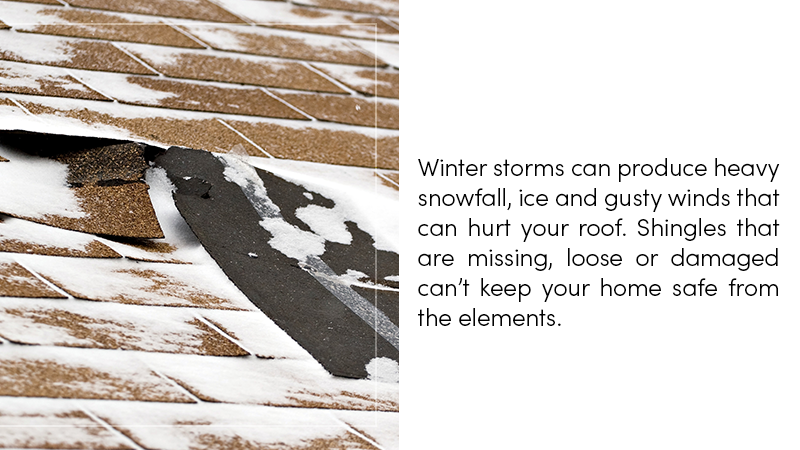
The other reason is that damage compounds. A roof with lifted shingles or failed flashing going into winter takes freeze-thaw cycles, wind and occasionally ice for three months. What would have been a repair in November can be a deck replacement in March.
One honest note: don’t expect a dramatic off-season discount. Materials cost what they cost and crews get paid either way. The benefit is availability and timing, not price, and a contractor promising a big winter discount is probably solving a different problem.
Get These Done Before Cold Weather
Worth doing in the fall, in rough order of how much they matter.
- Have the roof inspected, particularly if there were summer storms. Minor damage that’s survivable in October is not survivable through a freeze-thaw winter.
- Clear the gutters and downspouts. Blocked gutters are how ice dams get their start, and clogged downspouts put water where it shouldn’t be.
- Trim back limbs over the roof. Ice loading brings down branches that were fine all summer.
- Check the flashing and sealant around chimneys, vents and skylights, since those joints move with temperature.
- Look in the attic with a flashlight. Damp insulation or daylight through the deck is much cheaper to find now than in January.
And while someone’s working through the house, the non-roofing items worth the same trip: caulk gaps around windows and doors, have the heating system serviced before the first cold snap and the schedule fills, and disconnect and cover the outside faucets so a burst pipe doesn’t become the story of your December.
Don’t Wait Out the Season on a Damaged Roof
If there’s active damage, waiting until spring is the expensive option. Water that gets into a deck in December stays there, and everything it touches gets worse over three months of cold.
We’d rather look at it in January and tell you it can wait than look at it in April and tell you what it cost to wait.
Book a Winter Inspection
L&L Contractors works year-round across Murfreesboro, Nashville, Franklin, Brentwood, Smyrna, Spring Hill and the rest of Middle Tennessee. We’ll tell you what your roof needs now, what can safely wait for warmer weather, and what shouldn’t.
Call (615) 577-9103 or book a free roof inspection online.

6 thoughts on “Can You Roof in Winter? What Works and What Doesn’t”
I appreciate your comments on how getting roof work done in the winter is good because it is more comfortable for the contractors than doing it in the summer and because you don’t want the weather in the winter to make any issues worse if you wait too long to get them fixed. I have a small leak in my roof and some loose tiles that I feel like could result in other leaks if I let them sit over the winter. I should definitely find a roofing company who can fix my roof as soon as possible.
When you are looking for roof maintenance, it is best to have it done sooner rather than later. Roofing repair and maintenance should never be put off if you can help it, because problems will only become worse and more costly to repair.
My dad was having a hard time deciding if we should have our roof fixed this coming winter. It was explained here that leaks can get worst and should be dealt with right away. Furthermore, it’s recommended to hire professional roofers for quality roof repair.
I like how you said that by hiring professional roof inspectors, you are able to stop problems from getting worse or putting your home in danger of developing water damage and mold. I think it’s so much easier to prevent small problems from growing than it is to fix large problems after they’ve caused significant damage. My friend recently had a strong storm pass through her neighborhood, and she isn’t sure if hiring a storm damage repair business is necessary. I’ll definitely recommend that she do find a storm damage repair service in her area to come out and assess the damage on her roof and surrounding areas, to ensure that there are no problems that will become serious with time.
There are more shingles missing off my roof than I’d like and I really want to get them fixed before it starts snowing badly. Now as you said, these broken shingles can cause leaks which will get worse over time. I don’t want to risk that so chances are, I’ll see about hiring someone next weekend to come out and fix it for me.
I agree that contracting roofers to work during the winter is important. The tips provided in this article are interesting and insightful. I was unaware that some materials such as metal are unaffected in the winter.
Comments are closed.